Set up a small bedroom around its usable edges
Keep essential routes and storage accessible when a bed takes up most of the room.
Measure the room with the bed dressed
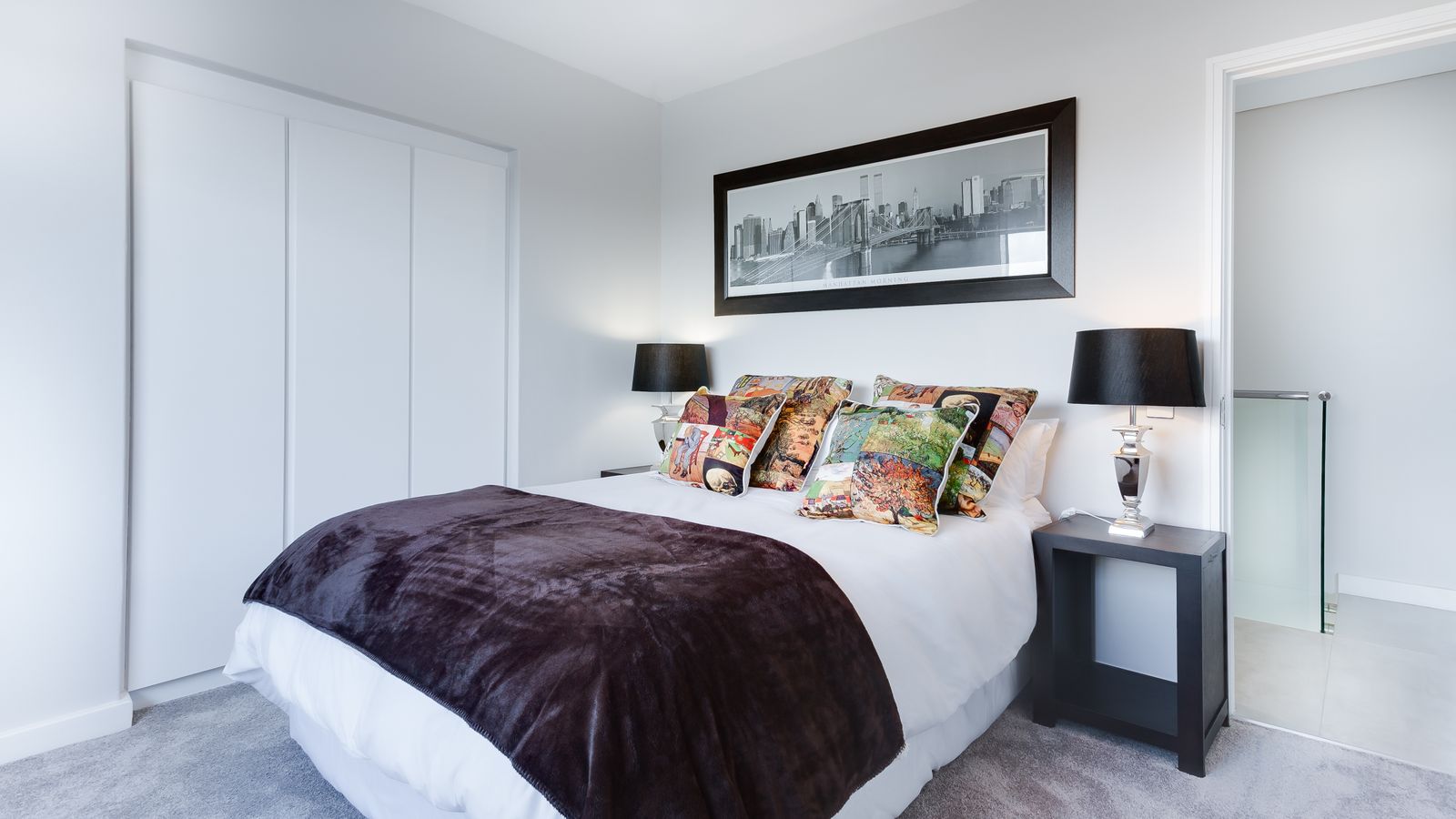
A bare mattress is unusually cooperative. Its edges end exactly where you expect, it has no quilt hanging over one corner, and it never leaves a slipper beside the wardrobe. Start your measurements with a made bed, or use a sheet and pillows on a taped outline to represent how much room it takes up in practice. Look for anything that makes the clear gap different at ankle, knee and shoulder height. A baseboard projects near the floor, a drawer handle can catch clothing, and the bedding may reach far enough to brush against each person who passes.
Make a wall-by-wall sketch that includes the bedroom door, sills, radiator, wardrobe handles and plugs. Mark which doors swing and how far they actually open with the bed in its present position. Try taking a jacket from the back of the wardrobe. You need room to hold the open door, see what is behind the jackets, pull one out and step clear. An opening that works when you stand to one side may still be a nuisance with a load of washing in your hands.
A deep drawer needs space to come forward and space for someone to stand or crouch at it. Draw the projection of its front when fully open. If the bottom drawer stops a little short beside the bed, find out whether you can pick up a folded garment without digging blindly. Depending on the arrangement, moving the dresser to another side of the room may get more use out of its volume than replacing it with a shallower one. Record the worst collision as plainly as possible. “The wardrobe door stops at the quilt” gives you a more useful starting point than “The room feels crowded.”
Find out which bedside edge can take the narrower gap
The most useful route may be from the entrance to the wardrobe or from one sleeper's side of the bed to the bathroom. Walk it after closing the door and turning off the ceiling light. Think about the side each person gets out on, how often they get up at night and whether they are carrying anything. Protect the route used by the person who needs more room to turn. A symmetrical layout can feel calm from the window, yet both side gaps may be too small to work well.
One bed edge against a wall can make sense in a room for a single sleeper. It may also be possible to leave a slight gap to reach the fitted sheet from the foot. Try that maneuver with your actual bedding. Repeat it while taking off a heavy cover that needs someplace to land. Moving a mattress away from the wall every week is quite different from moving it once during a layout exercise. A lower or lighter bed frame might be easier to manage, if it remains comfortable for getting in and out.
If two adults use the room, assign the side that needs a clear approach before building around the ideal view of the headboard. A change of ten inches can give one side adequate space and leave the other inaccessible, so check both with two people using the room. Look down at the edges of nearby rugs, particularly where the feet land on waking. It may be more pleasant to run an easy-to-maintain rug at the foot or along one edge than to leave a loose corner in a route heavily used in darkness.
Give each sleeper a switch, a glass and a clear floor
A narrow bedside surface is enough if it holds the things you reach for while lying down. Collect those things before choosing furniture. Try a glass, phone, book and a small tray on a stool or a cardboard box at different heights. Reach for each item from your usual sleeping position. A surface at the same level as the mattress might feel generous, but a lamp or headboard can consume the easy landing area. A small piece positioned toward the top of the mattress can free the foot end for standing up.
On the narrow side of the bed, try a wall shelf or use a headboard with a proper shelf built in. Check the surface against the way you sit up to read. A high shelf over the pillow or a projecting lamp can be in the way as you move. Follow the fixing requirements for the wall and the product before putting weight above the bed. A lamp with a low-footprint base or a wall-mounted reading light may give you freedom to remove one of two large nightstands.
Use the switch from a few ordinary positions. Sit with your pillow at its normal height and lie down with the other light off. You should be able to reach what you need without turning on the brightest fixture. If a light has an in-line switch, secure the cord along an edge so the switch keeps its place and the cord stays away from the walking route. For a new socket or hard-wired fixture, ask an electrician to review the location and the existing supply before you depend on it. The practical layout can be tested with a movable lamp while you decide.
Match the storage location to when clothes come out
Open the wardrobe at the time you usually get dressed. If the bedroom is often dark then, check whether you can select and reach the clothing you expect to wear. It might be helpful to give everyday pieces a zone near the opening where you can see the colors and take a hanger without moving the door. Put laundry in a container that can be picked up from a place you can reach without leaning over the bed. At a cramped edge, deep open shelves may be useful for stored items and harder to use for small, frequently handled pieces.
Keep trial storage simple. Mark two shelves for current clothes and move the winter spare blanket to a place you can reach a few times a year. Give short trips their own convenient locations. A towel you use every evening has a better claim to a reachable shelf than a box of extra pillow covers. Spare things stored under the bed should fit through the actual pulling gap. Measure the container along with the space it needs when your fingers are on its handle. A wide bin with small wheels is still hard to get out if the wall forces it to turn beside a bed leg.
If your wardrobe uses sliding doors, see how the doors overlap at their stops. A sliding door can clear a tight aisle and cover the drawer you want to open. Try that drawer behind each panel position. For a freestanding wardrobe, consider whether another wall can accommodate the existing piece and let its door open fully. Keep the unit installed as intended by its maker, including any required anchoring, and move it with suitable help. Make the test with paper outlines before shifting the furniture itself.
Rehearse a morning when someone else is asleep
Leave a set of clothes where it usually goes and test getting dressed before sunrise. If someone in the room still needs darkness, see whether a narrow beam of light near the wardrobe is enough to find a pair of socks. A light near the floor can help with the route, and a more directed one can make the storage area easier to use. Observe what the beam catches when the door is open. Bright light reflected in a mirror or off a pale adjacent wall can reach the bed even when the bulb does not face it.
Carry out an ordinary task in reverse. Go in during daylight, put folded washing away, place a book by the bed and close the curtains. Items that require you to cross the narrowest side might be easier to put away in the evening than in a rush in the morning. If you end up laying washing on the mattress to sort it every time, consider a small clear surface outside the room or a shelf inside the wardrobe where one basket fits. Retain the floor for the activities a floor serves best.
An example helps narrow the choices. In a room where a wardrobe hits the side of a double bed, you could try rotating the bed so its foot faces the opening. First mock up the rotation with the nightstand, the door swing and the bedding marked. The change may give the wardrobe clearance but direct foot traffic past the wrong side of a sleeper. Another attempt might shift the bed a little toward the window, keep a wall shelf on that side and put one deeper nightstand on the clear edge. Test both plans against the two ordinary routines before pricing furniture.
An edge near the window has one last job when the weather changes. Open the window as you normally do and check whether you can move the curtains without leaning above the mattress. If you use a bedside fan, give it a stable position and a cord route along the wall. Check that its position leaves the bedside controls available in winter as well as summer.
Write down the new clearances after the bed is in position, and watch which pieces of tape get crossed during the next few days. Open windows, remove laundry and change the sheets once before fitting anything permanent. The arrangement earns its place if the route remains friendly in thick socks, with a bundle of sheets in both hands, and during the quiet few minutes when only one person is awake.